What Are Crypto Trading Signals?
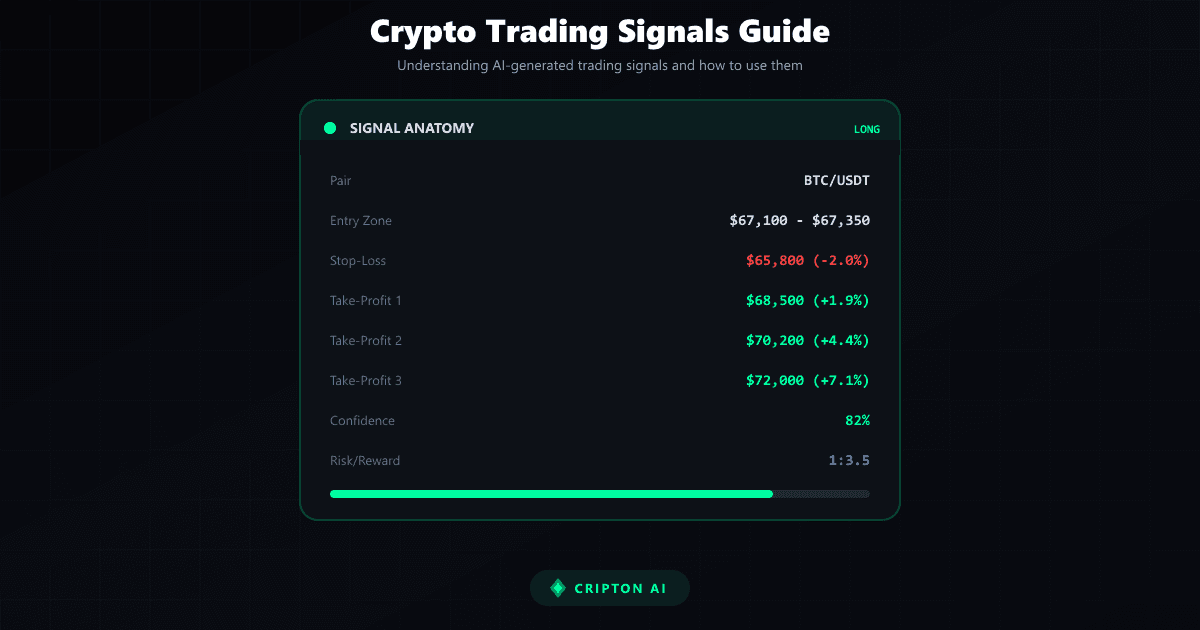
A crypto trading signal is a recommendation to buy or sell a specific cryptocurrency at a particular price, with defined exit points. Signals typically include: the asset (e.g., BTC/USDT), direction (LONG or SHORT), entry price or zone, take-profit targets (one or more TP levels), stop-loss level, and sometimes a confidence score or risk rating.
Trading signals can be generated by human analysts, algorithmic systems, or AI models. They serve as actionable suggestions — not guaranteed outcomes. Think of them as a structured analysis condensed into a specific trade setup. Professional traders use signals as one input alongside their own research, while newer traders may rely on them more heavily as a learning tool to understand market analysis in practice.
How AI Generates Trading Signals
Modern AI-powered signal systems like Cripton AI use multiple data sources and analytical methods to generate signals. The process typically involves: Technical Analysis — scanning hundreds of indicators across multiple timeframes including RSI, MACD, Bollinger Bands, volume profiles, and support/resistance levels.
Order Flow Analysis — examining order book depth, VPIN (Volume-Synchronized Probability of Informed Trading), and trade imbalances to detect institutional activity. Market Regime Detection — using Hidden Markov Models and volatility clustering to classify whether the market is trending, ranging, or in a risk-off state.
On-Chain Data — analyzing whale wallet movements, exchange inflows/outflows, and funding rates. Monte Carlo Risk Assessment — running thousands of simulated scenarios to estimate the probability distribution of outcomes. The AI synthesizes all these inputs to produce a signal only when multiple factors align with sufficient confidence.
Reading a Signal: Entry, Exit, SL, TP Explained
Understanding signal components is critical before acting on any recommendation. Entry Price is the price at which you open the position. Some signals provide an entry zone (e.g., $59,800 - $60,200) rather than a single price, giving you flexibility. Stop-Loss (SL) is the price at which you close the position to limit losses.
If Bitcoin enters at $60,000 with a SL at $58,500, your maximum loss per unit is $1,500 (2.5%). Never move your stop-loss further away from entry — this turns a calculated risk into an uncontrolled one. Take-Profit (TP) is your target exit price for capturing gains. Many signals include multiple TP levels (TP1, TP2, TP3) where you can close portions of your position at each level.
Risk-Reward Ratio compares potential loss to potential gain. A signal with entry at $60,000, SL at $58,500, and TP at $64,500 has a risk-reward ratio of 1:3 ($1,500 risk vs $4,500 reward). Professional traders generally require a minimum 1:2 ratio.
Signal Accuracy and Realistic Expectations
No signal provider achieves 100% accuracy — and any that claims to is fraudulent. In practice, professional signal systems operate in the 55-70% accuracy range on their primary timeframes. What matters more than accuracy is expected value: a system with 55% accuracy but a 1:3 risk-reward ratio will be profitable over time, while a system with 80% accuracy but a 3:1 risk-reward ratio may not be.
Key metrics to evaluate signal quality include: Win Rate (percentage of signals that hit at least TP1), Average Risk-Reward Ratio, Maximum Drawdown (largest losing streak), Sharpe Ratio (risk-adjusted returns), and Sample Size (at least 100+ signals for statistical significance). Be skeptical of any service showing only their best trades, displaying unrealistic returns, or lacking a verified track record.
Free vs Paid Crypto Signals
Free signals are widely available through Telegram groups, social media, and free tiers of signal platforms. They serve as an educational tool and can be useful for paper trading practice. However, free signals often come with limitations: delayed delivery, fewer trading pairs, no risk management framework, and sometimes conflicts of interest (the provider may front-run the signal).
Paid signal services typically offer: real-time delivery, comprehensive risk parameters (SL/TP for every signal), historical performance data, multiple asset coverage, dedicated support, and advanced features like automated execution. The best approach for beginners is to start with free signals in paper trading mode — this lets you evaluate quality without risking capital.
Cripton AI offers a free tier with access to AI-generated signals that you can practice with before committing real funds.
How to Use Cripton AI Signals
Cripton AI generates signals using a multi-layer AI pipeline that processes technical, on-chain, and market regime data. Each signal includes: the trading pair, direction, entry zone, stop-loss level, multiple take-profit targets, confidence score (0-100), and a risk assessment powered by Monte Carlo simulations.
To use signals effectively: Step 1 — Review the signal confidence and risk metrics before acting. Higher confidence signals have stronger multi-factor alignment. Step 2 — Check the risk-reward ratio. Ensure it meets your minimum threshold (recommended 1:2 or better). Step 3 — Size your position appropriately.
Never risk more than 1-2% of your total capital on a single trade. Step 4 — Set your stop-loss immediately upon entry. Step 5 — Consider taking partial profits at TP1 and trailing your stop to breakeven for the remainder. Step 6 — Log every trade in your journal for performance review.
Trading Signals FAQ
Are crypto trading signals legal? Yes, signal services are legal educational tools. They are not regulated investment advice in most jurisdictions. Can I automate signal execution? Yes, Cripton AI can automatically execute signals through your connected Binance API. Should I follow every signal? No. Review each signal against your own analysis and risk tolerance.
What timeframes do signals cover? Cripton AI signals span from 1-hour to daily timeframes, with most targeting 4-hour and daily charts. How many signals per day? The AI generates 2-8 signals per day across all supported pairs, depending on market conditions. During low-volatility periods, fewer signals are generated to maintain quality.
Frequently asked questions
What Are Crypto Trading Signals?
A crypto trading signal is a recommendation to buy or sell a specific cryptocurrency at a particular price, with defined exit points. Signals typically include: the asset (e.g., BTC/USDT), direction (LONG or SHORT), entry price or zone, take-profit targets (one or more TP levels), stop-loss level, and sometimes a confidence score or risk rating. Trading signals can be generated by human analysts, algorithmic systems, or AI models. They serve as actionable suggestions — not guaranteed outcomes. Think of them as a structured analysis condensed into a specific trade setup. Professional traders use signals as one input alongside their own research, while newer traders may rely on them more heavily as a learning tool to understand market analysis in practice.
How AI Generates Trading Signals?
Modern AI-powered signal systems like Cripton AI use multiple data sources and analytical methods to generate signals. The process typically involves: Technical Analysis — scanning hundreds of indicators across multiple timeframes including RSI, MACD, Bollinger Bands, volume profiles, and support/resistance levels. Order Flow Analysis — examining order book depth, VPIN (Volume-Synchronized Probability of Informed Trading), and trade imbalances to detect institutional activity. Market Regime Detection — using Hidden Markov Models and volatility clustering to classify whether the market is trending, ranging, or in a risk-off state. On-Chain Data — analyzing whale wallet movements, exchange inflows/outflows, and funding rates. Monte Carlo Risk Assessment — running thousands of simulated scenarios to estimate the probability distribution of outcomes. The AI synthesizes all these inputs to produce a signal only when multiple factors align with sufficient confidence.
How to Use Cripton AI Signals?
Cripton AI generates signals using a multi-layer AI pipeline that processes technical, on-chain, and market regime data. Each signal includes: the trading pair, direction, entry zone, stop-loss level, multiple take-profit targets, confidence score (0-100), and a risk assessment powered by Monte Carlo simulations. To use signals effectively: Step 1 — Review the signal confidence and risk metrics before acting. Higher confidence signals have stronger multi-factor alignment. Step 2 — Check the risk-reward ratio. Ensure it meets your minimum threshold (recommended 1:2 or better). Step 3 — Size your position appropriately. Never risk more than 1-2% of your total capital on a single trade. Step 4 — Set your stop-loss immediately upon entry. Step 5 — Consider taking partial profits at TP1 and trailing your stop to breakeven for the remainder. Step 6 — Log every trade in your journal for performance review.
Sources & references
Cripton AI is not affiliated with these platforms and does not endorse them. Verify each platform’s licensing in your country before using it.
Risk Disclaimer
This guide is for educational purposes only and does not constitute financial advice. Trading signals are analytical tools and not guarantees of profit. All cryptocurrency trading involves substantial risk of loss. Past signal performance does not guarantee future results. Only trade with capital you can afford to lose.
Ready to start trading?
Create a free account and practice with paper trading — zero risk.
Start Free TrialPrevious Guide
Grid Trading Explained: How Grid Bots Work in Crypto
Next Guide
Copy Trading Guide: How to Copy Trade Crypto in 2026
Keep learning
Live crypto prices
View all prices ›