What Is Grid Trading?
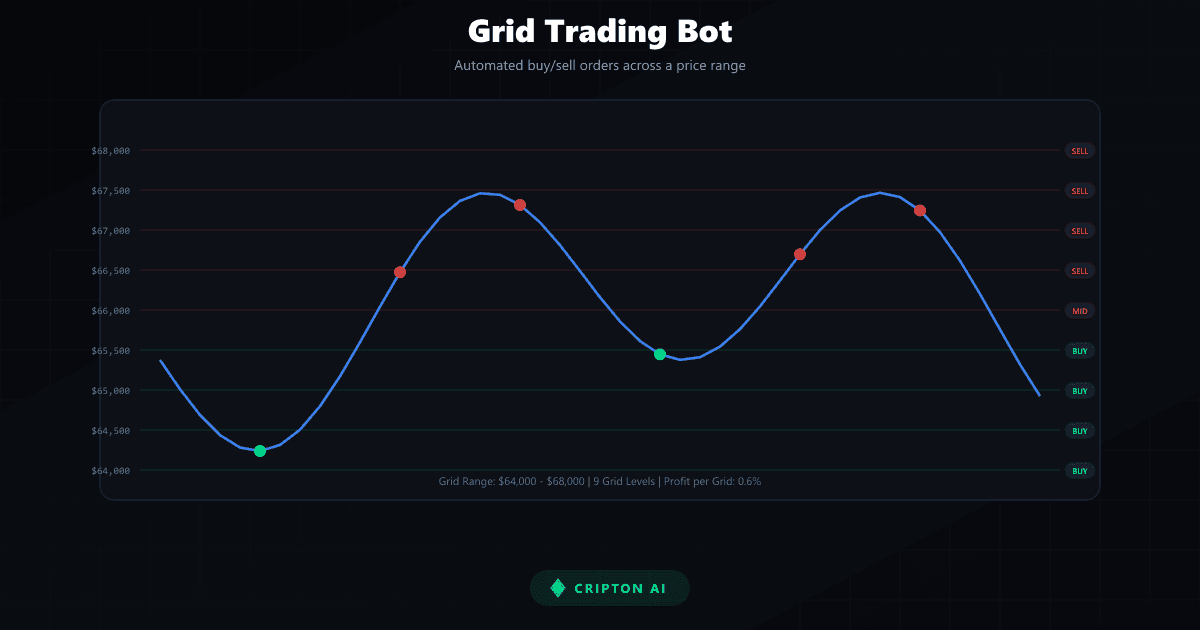
Grid trading is an automated strategy that places a series of buy and sell orders at predefined price intervals within a specified range. The concept is simple: buy low, sell high — repeatedly. Imagine a price chart overlaid with horizontal lines evenly spaced apart. Each line represents a price level where the bot either buys or sells.
As the price oscillates up and down, the bot captures small profits on each completed buy-sell cycle. Grid trading originated in forex markets but has become enormously popular in cryptocurrency due to the high volatility and 24/7 market hours. Unlike trend-following strategies that require the market to move in one direction, grid trading thrives in sideways, ranging markets where the price bounces between support and resistance levels.
This makes it a complementary strategy to DCA bots, which perform better in trending conditions.
How Does a Grid Trading Bot Work?
A grid bot operates by dividing a price range into multiple levels and placing alternating buy and sell orders. Here is how it works step by step: First, you define an upper price limit and a lower price limit — this is your grid range. The bot then divides this range into N equal intervals (called grid levels).
At each level below the current price, the bot places a buy limit order. At each level above the current price, it places a sell limit order. When the price drops and triggers a buy order, the bot immediately places a corresponding sell order one grid level above. When the price rises and triggers a sell order, it places a new buy order one grid level below.
Each completed buy-sell pair generates a small profit equal to the grid spacing minus trading fees. Over hundreds of cycles, these micro-profits accumulate into meaningful returns — provided the price stays within your defined range.
Arithmetic vs Geometric Grids
There are two main types of grid spacing. Arithmetic grids use equal absolute price differences between each level. For example, if Bitcoin is at $60,000 with a $500 spacing, the levels would be $59,500, $60,000, $60,500, $61,000, and so on. This approach works well when the price range is relatively narrow.
Geometric grids use equal percentage differences between levels. Instead of $500 apart, each level might be 1% apart. This means levels are closer together at lower prices and further apart at higher prices. Geometric grids are generally preferred for crypto because they account for the exponential nature of price movements — a $500 move matters more at $10,000 than at $100,000.
Cripton AI supports both arithmetic and geometric grid configurations, allowing you to choose based on the specific asset and market conditions.
Best Market Conditions for Grid Trading
Grid trading performs best in specific market environments. The ideal condition is a ranging or sideways market where the price oscillates between clear support and resistance levels without a strong directional trend. During these periods, the price repeatedly crosses grid levels, triggering multiple buy-sell cycles.
Grid bots struggle in two scenarios: strong uptrends (the price moves above your grid range, and you miss out on gains because all sell orders are filled) and strong downtrends (the price falls below your grid range, leaving you with unrealized losses on bought positions). Volatility is your friend in grid trading — but only horizontal volatility, not directional.
Look for assets with high daily price swings but stable weekly ranges. Consolidation phases after major moves are particularly profitable for grid bots.
Setting Up a Grid Bot on Cripton AI
Setting up a grid bot on Cripton AI is straightforward. Step 1: Connect your Binance API keys with trade-only permissions. Your keys are encrypted with AES-256 and Cripton AI never has withdrawal access. Step 2: Navigate to the Bots section and select Grid Bot. Step 3: Choose your trading pair — BTC/USDT and ETH/USDT are popular choices for grid trading due to their liquidity.
Step 4: Set your grid range. Analyze recent price action to identify support and resistance levels. Your range should cover the area where you expect the price to oscillate. Step 5: Configure the number of grid levels. More levels mean more frequent but smaller trades. Fewer levels mean less frequent but larger trades.
Step 6: Set your investment amount. The bot will distribute your capital across all grid levels. Step 7: Enable stop-loss protection to automatically close positions if the price falls significantly below your range. Step 8: Activate the bot and monitor from your dashboard.
Grid Trading Risk Management
Despite its systematic nature, grid trading carries significant risks. The primary risk is a price breakdown below your grid range. When this happens, you are left holding positions at a loss with no sell orders being triggered. To mitigate this: always set a stop-loss below your grid range, never allocate more than 10-20% of your portfolio to a single grid bot, diversify across multiple trading pairs, and avoid using high leverage.
Another risk is fee erosion — if your grid spacing is too tight, trading fees can eat into your profits. Ensure your grid profit per trade exceeds the round-trip fee cost (typically 0.1% maker + 0.1% taker on Binance). Finally, be aware of opportunity cost: capital locked in a grid bot during a strong bull run could have earned more from a simple buy-and-hold strategy.
Consider running grids alongside trend-following strategies for balanced exposure.
Grid Trading FAQ
How much money do I need to start grid trading? You can start with as little as $100 on Cripton AI, though $500+ is recommended for meaningful grid spacing. Is grid trading profitable? Grid trading is profitable in sideways markets but can incur losses in strong trends. No strategy guarantees profits.
Can I run multiple grid bots simultaneously? Yes, Cripton AI supports multiple concurrent bots across different trading pairs. What is the best grid spacing? This depends on the asset volatility. For BTC/USDT, 0.5-1% geometric spacing is a common starting point. How do I know when to stop a grid bot?
Consider stopping if the price breaks decisively out of your range, market conditions shift to a strong trend, or you have achieved your profit target.
Frequently asked questions
What Is Grid Trading?
Grid trading is an automated strategy that places a series of buy and sell orders at predefined price intervals within a specified range. The concept is simple: buy low, sell high — repeatedly. Imagine a price chart overlaid with horizontal lines evenly spaced apart. Each line represents a price level where the bot either buys or sells. As the price oscillates up and down, the bot captures small profits on each completed buy-sell cycle. Grid trading originated in forex markets but has become enormously popular in cryptocurrency due to the high volatility and 24/7 market hours. Unlike trend-following strategies that require the market to move in one direction, grid trading thrives in sideways, ranging markets where the price bounces between support and resistance levels. This makes it a complementary strategy to DCA bots, which perform better in trending conditions.
How Does a Grid Trading Bot Work?
A grid bot operates by dividing a price range into multiple levels and placing alternating buy and sell orders. Here is how it works step by step: First, you define an upper price limit and a lower price limit — this is your grid range. The bot then divides this range into N equal intervals (called grid levels). At each level below the current price, the bot places a buy limit order. At each level above the current price, it places a sell limit order. When the price drops and triggers a buy order, the bot immediately places a corresponding sell order one grid level above. When the price rises and triggers a sell order, it places a new buy order one grid level below. Each completed buy-sell pair generates a small profit equal to the grid spacing minus trading fees. Over hundreds of cycles, these micro-profits accumulate into meaningful returns — provided the price stays within your defined range.
Sources & references
Cripton AI is not affiliated with these platforms and does not endorse them. Verify each platform’s licensing in your country before using it.
Risk Disclaimer
This guide is for educational purposes only and does not constitute financial advice. Grid trading involves substantial risk, including the risk of loss exceeding your initial investment when using leverage. The price may move outside your grid range, resulting in unrealized losses. Past performance does not guarantee future results. Only trade with capital you can afford to lose.
Ready to start trading?
Create a free account and practice with paper trading — zero risk.
Start Free TrialPrevious Guide
VPIN & Order Book Imbalance: Algorithmic Crypto Trading
Next Guide
Crypto Trading Signals Explained: How to Read and Use Them
Keep learning
Live crypto prices
View all prices ›