What Is VPIN?
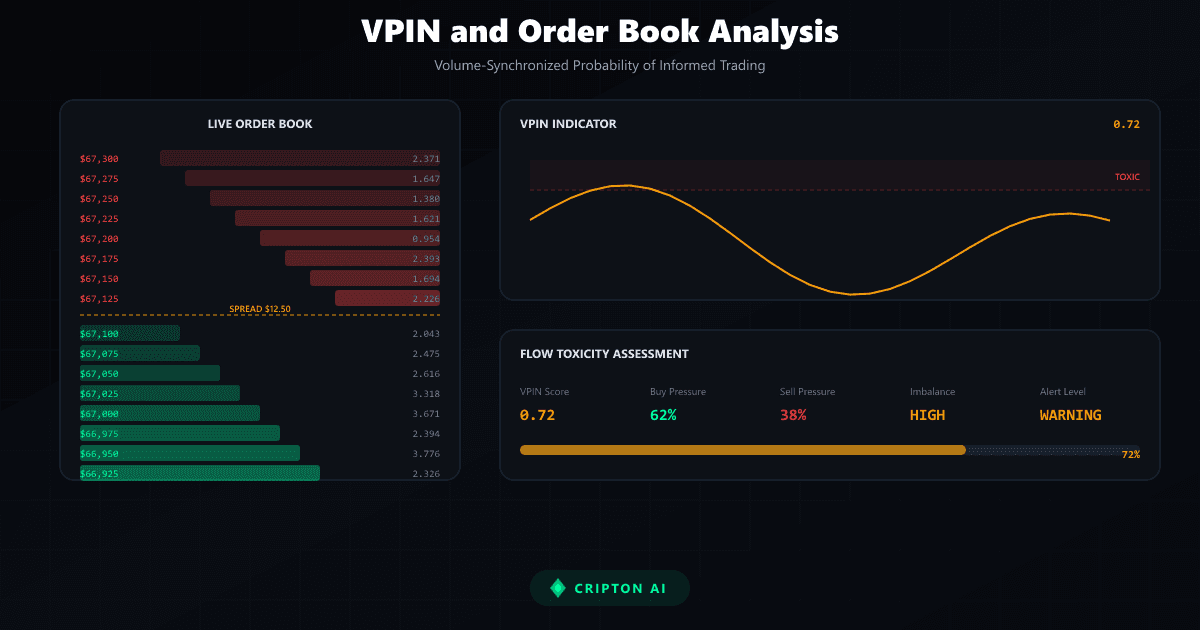
VPIN stands for Volume-Synchronized Probability of Informed Trading. It is a quantitative metric originally developed for traditional equity markets and adapted for crypto to measure the level of toxic order flow in the market. Toxic flow occurs when one side of the market (buyers or sellers) possesses information that the other side does not, creating an asymmetry that typically precedes significant price moves.
A high VPIN reading indicates that a large proportion of recent trading volume is likely driven by informed participants, such as institutional traders or market makers with superior information. In crypto markets, where whale activity can move prices dramatically, VPIN serves as an early warning system that detects accumulation or distribution phases before they become visible in the price chart.
How VPIN Works
Unlike traditional time-based indicators, VPIN groups trades into volume buckets rather than time intervals. Each bucket contains a fixed amount of traded volume, regardless of how long it took to fill. Within each bucket, the algorithm classifies trades as buyer-initiated or seller-initiated using the tick rule or bulk volume classification.
VPIN is then calculated as the average absolute imbalance between buy and sell volume across a rolling window of buckets. When VPIN is high, it means that trading is heavily skewed to one side, suggesting that informed traders are aggressively positioning before a move. This volume-synchronized approach is crucial because it naturally adapts to changes in trading activity: during quiet periods, buckets fill slowly, and during volatile periods, they fill rapidly, ensuring the metric always reflects the most recent market microstructure.
Order Book Imbalance Explained
Order book imbalance measures the difference between the total bid volume and total ask volume at or near the best prices in the order book. When there is significantly more bid volume than ask volume, it suggests strong buying pressure and potential upward price movement. Conversely, when ask volume dominates, it signals selling pressure.
The imbalance ratio is typically calculated as (bid_volume - ask_volume) / (bid_volume + ask_volume), yielding a value between -1 and +1. Large positive values indicate buying dominance while large negative values indicate selling dominance. Order book imbalance provides a real-time snapshot of supply and demand dynamics and is especially useful when combined with VPIN, as both metrics together paint a comprehensive picture of who is trading and in which direction the smart money is flowing.
How Cripton AI Uses VPIN and Order Flow
Cripton AI calculates VPIN in real time for every monitored trading pair, continuously updating volume buckets as new trades arrive. The VPIN reading is combined with the platform's Hidden Markov Model (HMM) regime detection system, which classifies the current market state as trending, ranging, or volatile.
When VPIN spikes above a critical threshold during a ranging regime, it often signals an impending breakout, and the system adjusts signal confidence accordingly. High VPIN in a trending regime may indicate trend exhaustion as informed traders begin to take profits. The order flow data is also fed into the signal scoring algorithm, where it influences the final confidence level of each trade signal.
This multi-layered approach ensures that Cripton AI's signals account not just for price patterns, but for the underlying flow of institutional and informed capital.
Practical Tips and Limitations
VPIN spikes have historically preceded major market crashes and flash crashes, making it a valuable leading indicator. However, VPIN should never be used as a standalone trading signal. False positives occur when large volume enters the market for non-informational reasons, such as index rebalancing or automated liquidations.
Always combine VPIN readings with price action analysis, volume profile, and other technical indicators for confirmation. Keep in mind that VPIN is most effective on liquid trading pairs where volume data is reliable; on low-liquidity pairs, a single large order can artificially inflate the metric. Additionally, exchange-specific data quality varies, so cross-referencing VPIN across multiple venues provides a more robust signal.
Treat VPIN as one component of a broader risk and signal framework rather than a magic predictor.
Frequently asked questions
What Is VPIN?
VPIN stands for Volume-Synchronized Probability of Informed Trading. It is a quantitative metric originally developed for traditional equity markets and adapted for crypto to measure the level of toxic order flow in the market. Toxic flow occurs when one side of the market (buyers or sellers) possesses information that the other side does not, creating an asymmetry that typically precedes significant price moves. A high VPIN reading indicates that a large proportion of recent trading volume is likely driven by informed participants, such as institutional traders or market makers with superior information. In crypto markets, where whale activity can move prices dramatically, VPIN serves as an early warning system that detects accumulation or distribution phases before they become visible in the price chart.
How VPIN Works?
Unlike traditional time-based indicators, VPIN groups trades into volume buckets rather than time intervals. Each bucket contains a fixed amount of traded volume, regardless of how long it took to fill. Within each bucket, the algorithm classifies trades as buyer-initiated or seller-initiated using the tick rule or bulk volume classification. VPIN is then calculated as the average absolute imbalance between buy and sell volume across a rolling window of buckets. When VPIN is high, it means that trading is heavily skewed to one side, suggesting that informed traders are aggressively positioning before a move. This volume-synchronized approach is crucial because it naturally adapts to changes in trading activity: during quiet periods, buckets fill slowly, and during volatile periods, they fill rapidly, ensuring the metric always reflects the most recent market microstructure.
How Cripton AI Uses VPIN and Order Flow?
Cripton AI calculates VPIN in real time for every monitored trading pair, continuously updating volume buckets as new trades arrive. The VPIN reading is combined with the platform's Hidden Markov Model (HMM) regime detection system, which classifies the current market state as trending, ranging, or volatile. When VPIN spikes above a critical threshold during a ranging regime, it often signals an impending breakout, and the system adjusts signal confidence accordingly. High VPIN in a trending regime may indicate trend exhaustion as informed traders begin to take profits. The order flow data is also fed into the signal scoring algorithm, where it influences the final confidence level of each trade signal. This multi-layered approach ensures that Cripton AI's signals account not just for price patterns, but for the underlying flow of institutional and informed capital.
Sources & references
Cripton AI is not affiliated with these platforms and does not endorse them. Verify each platform’s licensing in your country before using it.
Risk Disclaimer
VPIN is an advanced metric and does not guarantee successful predictions.
Ready to start trading?
Create a free account and practice with paper trading — zero risk.
Start Free TrialPrevious Guide
Monte Carlo VaR for Crypto Portfolio Risk Management
Next Guide
Grid Trading Explained: How Grid Bots Work in Crypto
Keep learning
Live crypto prices
View all prices ›